

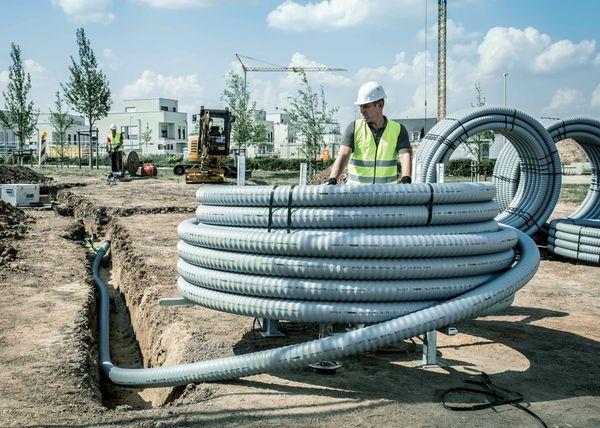
Heat pumps and district heating are playing an increasingly important role in the UK’s transition towards lower-carbon heating. However, selecting the right heat source is only part of the challenge. Heat must also be transported efficiently from the plant room or energy centre to the buildings it serves.
This is where pipework design becomes particularly important. Poorly sized pipes, unnecessarily long routes and inadequate insulation can increase heat losses, pumping costs and installation time. These issues can affect the performance and running costs of a heating system throughout its operational life.
Pre-insulated pipe systems provide a practical solution by combining the carrier pipe, thermal insulation and protective outer casing into a single assembly designed for underground applications. When specified correctly, they can simplify installation and help maintain efficient heat distribution across residential developments, commercial buildings and district heating networks.
- Why pipework matters for heat pumps
Heat pumps transfer heat from sources such as outdoor air, the ground or water. Their efficiency depends on several factors, including source temperature, required flow temperature, system controls and the design of the heating distribution system.
In many applications, lower heating flow temperatures help improve heat pump efficiency. However, the distribution network must still deliver sufficient heat to each building while controlling pressure losses and unwanted heat transfer to the surrounding ground.
Pipe sizing should therefore take account of:
- Heat demand: the amount of energy required by the building or group of buildings.
- Flow and return temperatures: these influence the water flow rate needed to transfer the required heat.
- Pipe diameter: the internal diameter affects flow velocity and pressure loss.
- Route length: longer underground runs increase the total potential for heat loss and can increase pumping requirements.
On developments with several buildings, the network may include a main distribution line with smaller branches supplying individual properties. Each section needs to be sized for its own design duty rather than simply using the same diameter throughout.
Considering these factors early helps ensure the pipework is suited to the heat source and the wider heating system.
- Pre-insulated pipes for district heating
District heating networks distribute heat from a central energy centre to multiple buildings through insulated flow and return pipes. Depending on the scheme, the heat source may include large heat pumps, recovered heat or a combination of technologies.
Because the distribution pipes may run beneath roads, footpaths, car parks and landscaped areas, the system must be designed to manage heat losses while accommodating the practical demands of underground installation.
Pre-insulated pipes combine three main components:
- Carrier pipe: transports the heating medium between the heat source and the building.
- Thermal insulation: reduces heat transfer between the carrier pipe and the surrounding environment.
- Outer casing: provides external protection during handling, installation and buried service.
Vargo Pipes supplies the ECOPEX pre-insulated pipe system, which uses a PE-Xa carrier pipe, an oxygen diffusion barrier, polyurethane foam insulation and a polyethylene outer casing. The system is intended for buried heating applications.
This integrated construction can reduce the need to install separate insulation and protective layers on site. It can also help simplify material coordination and installation planning, particularly where several buildings require individual connections to a central heating network.
The selected system must still be checked against the project’s operating temperatures, pressure requirements, installation conditions and relevant manufacturer documentation.
- Choosing the right pipe configuration
The most suitable pipe configuration depends on the route layout, required heat output, available space and installation method. Selecting the arrangement early can help avoid unnecessary complications during excavation and installation.
UNO — separate flow and return pipes
UNO uses individual pre-insulated pipes for the flow and return lines. This arrangement can be useful where the two pipes need to follow separate routes or where the site layout requires greater flexibility in positioning them.
The design should account for trench width, pipe separation, bends and the locations of connections.
DUO — flow and return within one casing
DUO combines the flow and return carrier pipes within a shared outer casing. This can help consolidate the installation where both lines follow the same route, potentially simplifying handling and trench planning.
The appropriate size depends on the required flow rate, operating temperatures, hydraulic performance and available product specifications.
PLUS — enhanced insulation
For applications where reducing heat loss is a priority, enhanced insulation may be worth considering. Vargo Pipes offers PLUS insulation options on selected ECOPEX sizes.
The additional insulation should be assessed against the operating conditions, length of the distribution route and expected energy savings. A thicker insulation option may reduce heat loss, but the benefit should be compared with the additional material and installation cost.
There is no single configuration that suits every project. The objective is to select a system that meets the engineering requirements while remaining practical to install.
- Managing heat loss and energy efficiency
Heat loss from buried pipework is influenced by the temperature of the circulating water, the surrounding ground conditions, insulation thickness and the total length of the network.
For a short connection serving one building, the overall losses may be relatively modest. Across a large district heating network operating for long periods, however, even small losses per metre can accumulate into a significant amount of energy.
For example, an illustrative average heat loss of 15 watts per metre across a 100-metre route would equal 1.5 kW of continuous heat loss. If the same conditions applied for 4,000 operating hours, the total loss would be 6,000 kWh.
This is an illustrative calculation, not a measured performance figure for ECOPEX. Actual losses should be calculated using the relevant product data and project operating conditions.
When reviewing a proposed installation, engineers should consider:
- Whether the pipe route can be shortened without compromising the layout.
- Whether the selected insulation level is appropriate for the operating temperatures.
- Whether the flow and return temperatures can be optimised for the heat source.
- Whether the pipe diameter provides an appropriate balance between pressure loss and capital cost.
Looking at these factors together provides a more useful picture of system efficiency than considering the insulation specification alone.
- Pipe sizing and whole-life costs
Pipework is often assessed initially on purchase price, but the lowest-cost pipe is not necessarily the most economical option over the life of the heating system.
An undersized pipe can result in excessive pressure loss, increased pumping requirements and difficulty meeting the required heat output. An oversized pipe may increase material costs, excavation requirements and installation time without delivering a corresponding benefit.
The correct diameter depends on the design heat load, temperature difference, flow rate, allowable pressure drop and overall network arrangement.
This becomes especially relevant in low-temperature heat pump systems. Where the difference between flow and return temperatures is relatively small, a higher water flow rate may be needed to transport the same amount of heat. Pipe diameter and pressure loss therefore need careful consideration.
For larger projects, it is worth assessing the installed cost alongside expected pumping energy, thermal losses and maintenance requirements.
Vargo Pipes provides technical resources for its ECOPEX range, including heat-loss and pressure-loss information, to support the pipe selection process. Final sizing should be confirmed by the project’s designer using the applicable technical data.
- Installation considerations on UK projects
Underground pipework can be difficult and expensive to access once the trench has been backfilled. Good planning before installation is therefore essential.
Route coordination
The proposed pipe route should be coordinated with drainage, electrical services, water supplies, foundations and other buried infrastructure. This helps minimise clashes and avoids unnecessary changes once excavation has started.
Pipe lengths and site logistics
Ordering appropriate lengths can reduce offcuts, handling and unnecessary joints. Vargo Pipes offers cut-to-measure ECOPEX pipe lengths, helping contractors plan deliveries around the requirements of the installation.
Bends and connections
Flexible pipework can help accommodate changes in direction where site conditions restrict the route. However, the manufacturer’s minimum bend radius and installation instructions must be followed. Joint locations should also be planned so that connections can be installed, inspected and tested appropriately.
Bedding and backfilling
The trench preparation, bedding material, cover depth and backfill must meet the system manufacturer’s requirements and the project’s civil engineering specification. Pipework should be checked for damage, and the required inspections and tests completed before it is concealed.
These measures help reduce avoidable installation problems and make the completed network easier to document and hand over.
- UK heat-network regulation and technical assurance
The UK heat-network sector is moving towards a more formal regulatory and technical assurance framework.
Since January 2026, Ofgem has taken on a regulatory role for heat networks in Great Britain, with requirements covering areas including consumer protection, registration and the responsibilities of heat-network suppliers and operators.
The government is also developing the Heat Network Technical Assurance Scheme (HNTAS), intended to strengthen technical assurance across heat-network design, construction and operation.
For developers, consultants and contractors, this reinforces the importance of specifying suitable products and maintaining clear installation records. Relevant documentation may include product specifications, pipe sizes, insulation options, installation and test records, commissioning information and accurate as-built drawings.
Selecting an appropriate pipe system is only one part of compliance. The complete network must meet the applicable design, installation and regulatory requirements.
- How Vargo Pipes can support your project
Choosing the right pipework early in the design process can help reduce installation complications and provide greater certainty during procurement.
Vargo Pipes supplies ECOPEX pre-insulated pipework for heat pumps, district heating and other heating and cooling applications. Its product range and project support can help customers assess suitable configurations, sizes, insulation options, pipe lengths and associated fittings.
For a new development or refurbishment, the following information can help establish the most appropriate solution:
- The heat source and intended operating temperatures.
- The estimated heat demand and required flow rate.
- The proposed pipe route and approximate lengths.
- The preferred UNO or DUO configuration, where applicable.
- Any site access, trenching or installation constraints.
Providing this information at the quotation stage can help align product selection with the engineering design and installation programme.
Explore the ECOPEX pre-insulated pipe system or contact Vargo Pipes to discuss your project requirements.
Conclusion
The performance of a low-carbon heating system depends on more than the equipment generating the heat. The distribution network must also be designed to manage heat losses, control pressure drops and accommodate the practical requirements of installation.
Pre-insulated pipework offers a practical way to simplify underground distribution while supporting the thermal and hydraulic needs of heat pump and district heating systems.
By considering pipe configuration, insulation, sizing and route planning from the outset, project teams can make better-informed decisions and develop heating networks designed for long-term performance.
For UK projects, Vargo Pipes provides pre-insulated pipe solutions and project support to help engineers, contractors and developers select pipework suited to the requirements of each installation.